
VII SEMA Webinar
«The transferability of Machine Learning methods from Agriculture to Toxicology and Mutagenesis»
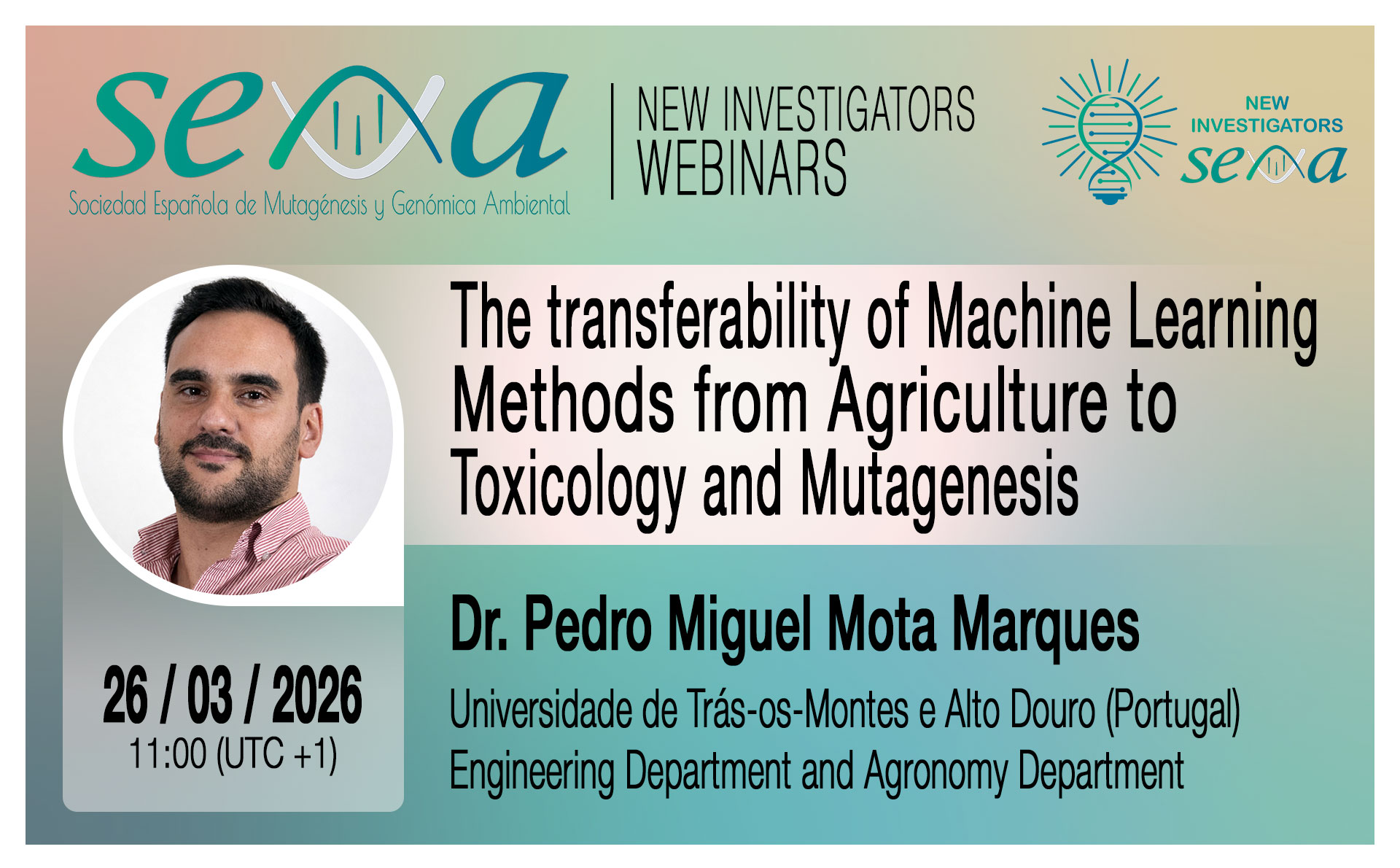
DESCRIPTION
This webinar explores how machine learning methodologies developed for precision agriculture can be transferred to other scientific domains, particularly toxicology and mutagenesis. The presentation begins with an overview of key concepts in remote sensing, including sensing platforms such as UAVs and satellites, sensor types, and the role of the electromagnetic spectrum in vegetation monitoring. It also introduces fundamental principles of machine learning and its role in analysing complex environmental datasets.
Several case studies from precision agriculture will then be presented, focusing on applications in vineyards, olive groves, and chestnut orchards. These include multi-temporal analyses for chestnut grove management, deficit irrigation monitoring in olive orchards, and machine learning models for predicting grape yield, pruning wood biomass, and leaf area index in vineyards.
The webinar concludes with a brief overview of how similar machine learning approaches are being applied in toxicology and mutagenesis, highlighting examples from recent scientific literature.
BIO
Dr. Pedro Miguel Mota Marques is a researcher specialized in remote and proximal sensing for precision agriculture, with extensive experience in monitoring key crops in northern Portugal, including vineyards, chestnut trees, and olive orchards. His work focuses on combining UAV, satellite, and spectroradiometer data with GIS-based analyses to support irrigation management, crop stress assessment, yield prediction, and sustainable land management. He has experience in the creation, curation, and validation of datasets for machine learning, as well as in the development and training of data-driven models for the analysis and prediction of agronomic parameters using remotely sensed and field data, including multispectral, thermal, and spectral information.